Why Go-Live Isn't the Finish Line: The UNRIVA Alignment Score Explained
“Why Go-Live Isn't the Finish Line: The UNRIVA Alignment Score Explained” - Seth Godin
Why Go-Live Isn't the Finish Line: The UNRIVA Alignment Score Explained
1. Why is our ERP live but not actually being used?
This is the question most consulting firms never answer directly. They talk about "adoption challenges" or "change management gaps" in the abstract, but they rarely explain what adoption actually looks like on the floor, or how to measure it before it becomes a crisis.
Here is the short answer: go-live and adoption are two different events, separated by weeks or months, and most organizations only find out how far apart they are after the damage is done.
2. The gap between go-live and adoption
A system going live means the software is installed, configured, and technically available to users. Adoption means people are actually using it the way it was designed to be used, instead of working around it.
Between those two points, a predictable pattern shows up:
Floor workers quietly return to spreadsheets because the new system feels slower for their specific task
Floor leaders start approving manual overrides just to keep production moving
Department heads see clean dashboards because the exceptions never make it into the system in the first place
None of this shows up as a failure. It shows up as a quiet, permanent workaround that gets treated as normal within a few months. By the time leadership notices the numbers do not add up, the workaround is embedded in the culture.
3. How the UNRIVA Alignment Score works
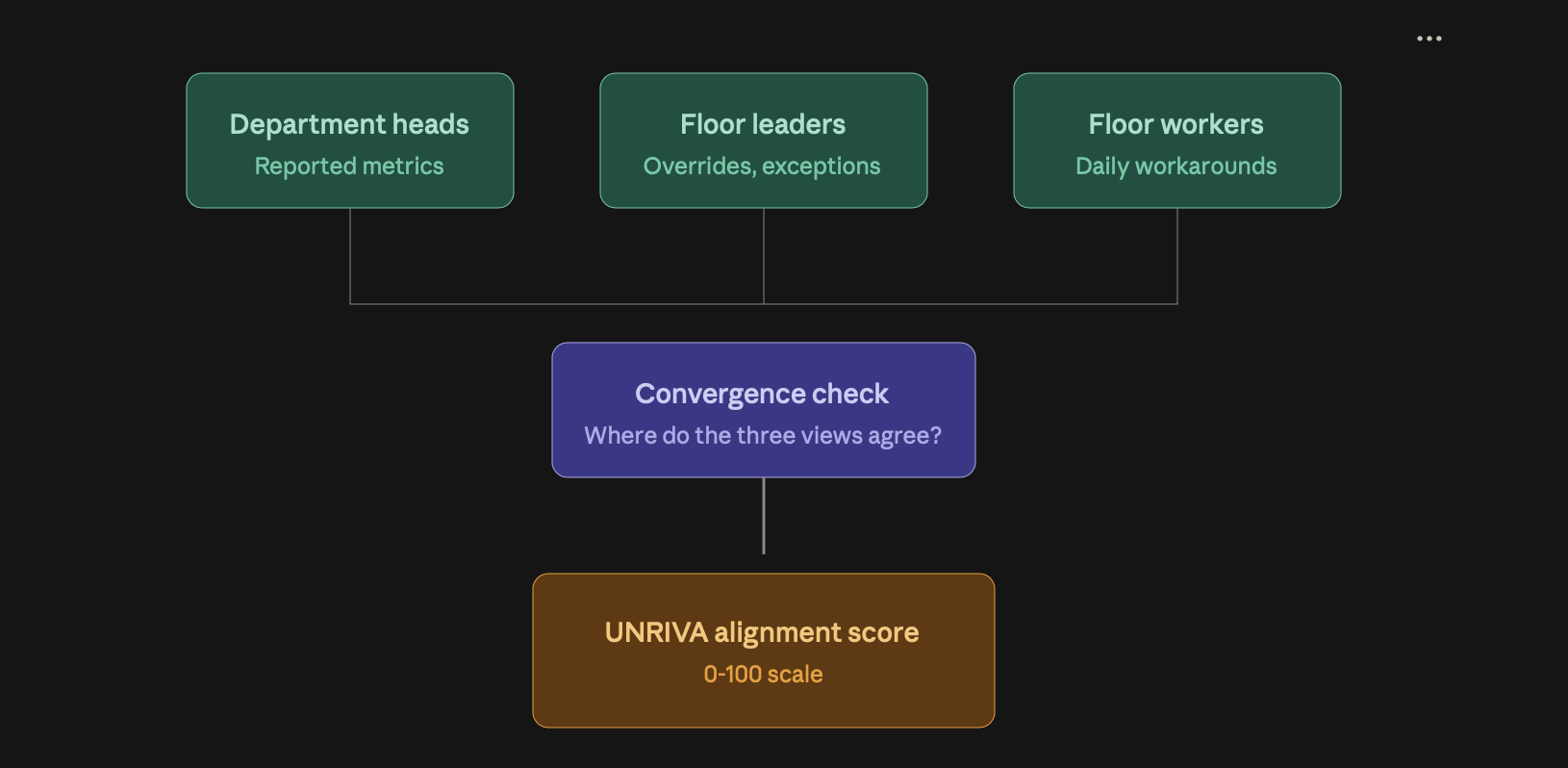
At Unriva, we built the UNRIVA Alignment Score specifically because "adoption" was too vague a word to manage against. It is a 0-100 score built from three role-specific discovery questionnaires, one each for Department Heads, Floor Leaders, and Floor Workers.
Each group is asked about the same operational reality from their own vantage point. The questions are not about opinions on the software. They are about specific behaviors: what gets entered into the system, what gets worked around, and where trust in the data breaks down.
The score is not one number pulled from a single survey. It is the alignment, or misalignment, between what each level of the organization believes is happening. A high score means all three levels see the same operational reality. A low score means the story changes depending on who you ask, which is usually the first sign that a workaround has already taken root.
4. Where this shows up in the UNRIVA Method
The Alignment Score is not a standalone diagnostic. It sits inside the Understand and Navigate phases of the UNRIVA Method, the first two steps in identifying where operational readiness actually stands before any technical or process change is recommended.
A low score during Understand tells us where to look. A low score that persists into Navigate tells us the gap is structural, not situational, and that the fix needs to happen at the process level, not just the training level.
This is also why the score matters most before a Reveal phase intervention is designed. Recommending a fix without first knowing where the misalignment lives is how organizations end up re-training people on a system they were never going to trust in the first place.
5. What a low score actually predicts
Organizations with a low Alignment Score at the pre-implementation or early post-go-live stage tend to see the same downstream problems regardless of industry: inventory counts that never reconcile, manual data entry that quietly replaces automated workflows, and a widening gap between what leadership reports and what actually happens on the floor.
Catching this early, before go-live or shortly after, is the difference between a two-week process correction and a multi-month rebuild of trust in the system.
6. Where to start
If your organization cannot currently answer "how aligned are Department Heads, Floor Leaders, and Floor Workers on whether the system reflects reality," that is the gap the Alignment Score is built to close. It is the first diagnostic step in every UNRIVA Method engagement, because no readiness assessment or implementation plan is reliable until that question has a real answer.