WHAT WE DO
Operational Readiness Isn't a Phase. It's a Standard.
Every service Unriva offers is built around one belief: that technology only performs as well as the operation it runs inside. We prepare your operation first — and protect it after.
We Meet You Where You Are.
Some organizations come to us before a system goes live. Some come to us after — when the system is running but the operation isn't. Some come to us because they're building something from scratch and need to get it right the first time.
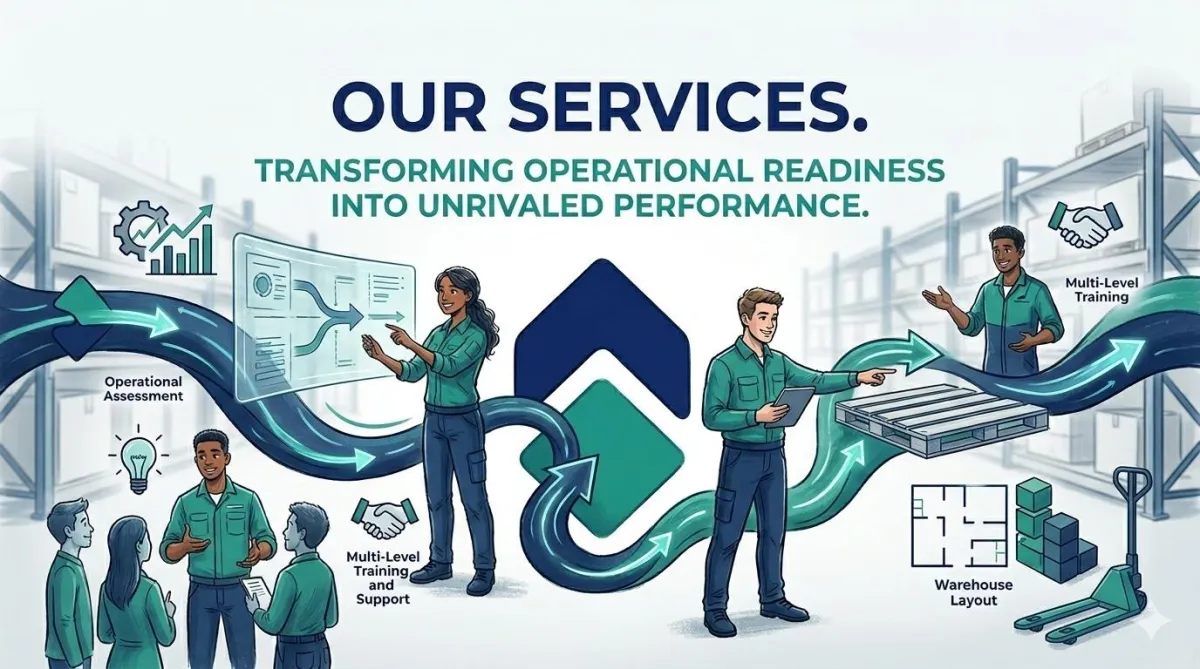
Wherever you are in that process, we have a defined way to help. Our four service areas are not a menu you pick from. They're a continuum — and depending on where your operation stands today, you may need one, two, or all four. We'll tell you honestly which ones apply and why.
01 of 04
Pre-Go-Live Operational Readiness
For organizations preparing to implement a new ERP, WMS, or YMS system — or currently mid-implementation and realizing the operation isn't as ready as it needs to be.
The Problem This Solves
Most organizations approach a system implementation the same way: they select the vendor, sign the contract, and hand the project to IT. Meanwhile, the departments that will actually use the system — materials, procurement, quality, warehouse operations, field teams — are still running the way they've always run.
When go-live arrives, the system is ready. The operation is not.
Processes that were never documented get entered into the system as best guesses. Department heads describe workflows that don't match what's happening on the floor. The vendor configures what they're told — not what the operation actually needs. And by the time anyone realizes the gap, the implementation team has moved on.
• We sit with each department to document what they actually do today — not what the org chart says they do
• We identify the gaps between current-state operations and what the new system will require
• We define future-state workflows that the system can be built around — specific enough to hand directly to your implementation team
• We facilitate cross-functional alignment sessions so that materials, procurement, quality, IT, and operations are working from a shared understanding before a single screen is configured
• We deliver a process readiness package that gives your vendor exactly what they need to configure a system that fits your operation
What We Do
What You Walk Away With
A documented current-state and future-state workflow for every function touching the system. Cross-functional alignment on requirements. And the confidence that when your system goes live, it was built for how your operation actually runs — not how someone assumed it did.
02 of 04
Warehouse Layout & Material Flow Design
For organizations building a new warehouse or distribution operation, redesigning an existing one, or launching a new site that needs a physical and operational structure from the ground up.
The Problem This Solves
A warehouse is not just a building. It is a system — and like any system, it performs exactly as well as it was designed to. When the physical layout doesn't match the operational flow, everything downstream suffers: receiving backs up, inventory gets misplaced, picks take longer than they should, and outbound shipments miss their windows.
For operations where field teams or construction sites depend on materials arriving on time and in full, a poorly designed warehouse isn't an inconvenience. It's a direct cost — every hour a crew sits idle waiting on materials is money the business will never recover.
What We Do
• We conduct a full assessment of your inbound and outbound volume, SKU profile, and delivery requirements
• We design the physical layout — receiving, put-away, storage, picking, staging, and outbound — so that material moves efficiently from the moment it arrives to the moment it leaves
• We align the physical flow to the logic of your ERP or WMS so the system reflects what's happening in the space, and the space supports how the system is designed to work
• We define the operational processes that govern each zone — who does what, when, in what sequence — so your team has a clear, repeatable playbook from day one
• We establish inventory placement strategy based on velocity, volume, and delivery priority so the right materials are always in the right location
What You Walk Away With
A warehouse designed to move materials — not store them. A layout that your team can operate consistently, your system can track accurately, and your field operations can depend on. Built before the first box arrives, so you're not redesigning under pressure after go-live.
03 of 04
System Training Across All Levels
For organizations whose teams need to actually use the system — not just know it was implemented. Particularly relevant when vendor training has already concluded or is limited in scope.
The Problem This Solves
Vendor training is not designed to make your team operationally fluent. It's designed to show them how the system works. Those are two very different things.
What typically happens: the implementation team runs a series of training sessions with department heads and key users in the weeks before go-live. The sessions cover system navigation, basic workflows, and role-specific functions. Then go-live arrives, and the people actually doing the work — the warehouse associates, the receiving clerks, the field personnel, the foremen — are handed a new system with minimal context and expected to perform.
When they struggle, they don't stop and ask for help. They find a workaround. And once a workaround becomes habit, it is extraordinarily difficult to unwind. The system is live. The operation is running beside it — not through it.
What We Do
• We develop role-specific training that speaks the language of each function — not generic system walkthroughs, but training built around the actual tasks each team member performs in the system every day
• We train the people on the floor and in the field, not just the managers in the conference room — because adoption happens at the point of execution, not in the boardroom
• We translate system logic into operational language so your team understands not just what to do, but why — and what the downstream impact is when steps are skipped or bypassed
• We run scenario-based training that puts your team through real operational situations inside the system before they encounter them on the job
• We identify resistance and adoption gaps early — before they become embedded workarounds — and address them directly with frontline teams and leadership
What You Walk Away With
A team that is confident in the system before they need to use it under pressure. Role-specific knowledge that sticks because it was built around actual job functions. And a significantly reduced risk of the workarounds, data inaccuracies, and process breakdowns that follow implementations where frontline training was an afterthought.
04 of 04
Post-Go-Live Support & Stabilization
For organizations that have already gone live and are not seeing the results they expected — or organizations preparing for go-live who want a defined support structure in place for what comes after.
The Problem This Solves
Go-live is not the finish line. For most organizations, it's where the real challenges begin.
The implementation team departs on schedule. The hypercare window closes. And your team — now responsible for running a live system in a live operation — starts encountering the situations that training didn't cover, the edge cases the vendor didn't anticipate, and the gaps between how the system was configured and how the operation actually needs to run.
Support tickets get submitted. Response times stretch. Your team starts making decisions in the system without full confidence — and those decisions compound over time into data integrity issues, process inconsistencies, and performance gaps that are increasingly difficult to trace back to their source. Two weeks of vendor support was never going to be enough. It was never designed to be.
What We Do
• We conduct a post-go-live operational review to identify what isn't working, where adoption has stalled, and where the system isn't being used as designed
• We embed with your team in the critical weeks after go-live to provide on-the-ground support at the point of execution — not just remote troubleshooting
• We identify and close adoption gaps before they become embedded workarounds — working directly with frontline teams to address resistance, confusion, and process deviations
• We review system data for early indicators of process breakdown — inventory discrepancies, receiving errors, fulfillment delays — and trace them back to root cause
• We provide structured stabilization support across all functions until the operation is running consistently, accurately, and with confidence at every level
What You Walk Away With
An operation that is actually performing — not just technically live. A team that is fully adopted and running the system as designed. And the assurance that the investment your organization made in new technology is delivering the return it was supposed to.
not sure where to start?
Most of Our Best Engagements Begin With a Single Question.
Most of our clients come to us knowing something isn't working — but not always sure which part of the problem we solve first. That's what the discovery call is for.
In 30 minutes, we'll listen to where your operation stands, ask the questions that help us understand the full picture, and tell you honestly which of our services applies — and in what order. There's no obligation and no pitch. Just a direct conversation about your operation.
Already know what you need? Reach out directly: [email protected]
our experience
We've Worked in Environments Like Yours.
Our team has operated inside large-scale manufacturing and distribution environments — not as outside consultants, but as the people responsible for making it work.
• Leading the pilot implementation of a Yard Management System that performed well enough to earn a nationwide rollout across a major manufacturing organization
• Implementing a freight management platform that transformed how carriers and inbound materials were coordinated across a multi-site operation
• Delivering the strongest inventory accuracy performance a large manufacturing client had seen in nearly a decade — after years of significant losses — through disciplined process implementation and cross-functional accountability
• Managing multi-site, mission-critical deployments in government and military environments where on-time execution across multiple locations simultaneously was non-negotiable
We bring that execution experience into every client engagement. When we walk into your operation, we're not learning what a warehouse looks like. We're applying what we've already built — to what you're building now.
ready to talk?
Let's Start With What Isn't Working.
You don't need a fully scoped project to have a conversation with us. Most of our engagements start with a simple question: where is your operation breaking down?
Book a 30-minute discovery call. We'll listen first, ask the right questions, and tell you honestly whether and how we can help. No sales pitch. No generic proposal. Just a direct conversation about your operation and what it would take to get it where it needs to be.
Prefer to reach out directly? [email protected]